Climate change poses challenges to the mining industry. It can impact the conditions at mining sites, both during operations and post-closure, and affect host communities and the environment, increasing the complexity of stakeholder interactions. This makes proactive climate change risk studies essential to strengthen resilience and adaptive capacity. While climate change can give rise to both physical and transition risks, this article focuses on assessing and managing physical risks.
A physical climate change risk analysis for a mining site typically involves three steps: (1) a site-specific climate change study to characterize chronic and acute physical hazards; (2) assessment of physical climate change risks and opportunities; and (3) prioritization of action plans to develop and implement adaptation measures to improve climate change resilience.
Climate change characterization includes analyzing the site’s meteorological conditions and how they evolve over representative time intervals (e.g., 30-year periods) extending to the end of the 21st century. Based on climate change projections, as described in the article, “Mining challenges in a changing climate”, environmental and social studies, design reports, management plans, and technical documentation, characterize the site’s exposure and vulnerability to physical hazards related to climate change. Project components are then classified according to spheres of influence, ranging from full-control to no-control: mining activities and infrastructure, uncontrolled infrastructure and supplies, external supply chains, and the communities of interest and the natural environment.
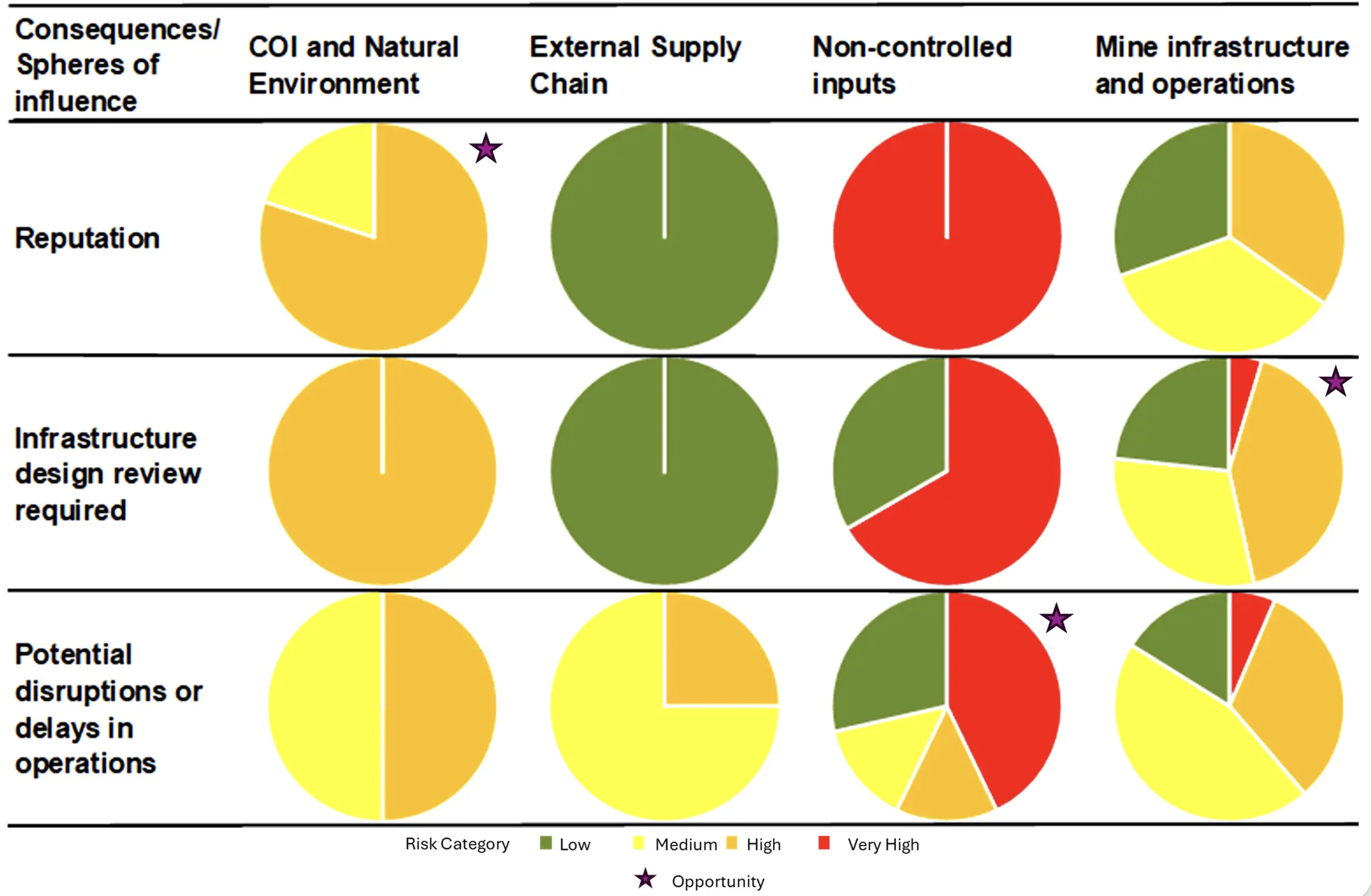
At SRK, a multidisciplinary team analyses hazard scenarios to identify consequences and probabilities, followed by the risk categorization. Individual risks are grouped to plan adaptation strategies. For physical hazards linked to climate change, consequence categories may include impacts on the mine’s reputation, the need to review infrastructure design, and the potential for increased operational interruptions or delays.
The accompanying Figure 1 summarizes a risk register by sphere of influence and consequence category, illustrating how risks and opportunities are distributed in a case study.
Adaptation strategies require active stakeholder involvement to integrate diverse perspectives into design reviews, operational procedures, and updates to control and monitoring plans. They should prioritize a holistic, site-wide approach rather than focusing solely on individual facilities, considering a range of potential climate scenarios.
It is also important to recognize that key risks may lie beyond a mine’s direct control, with catchment-wide water resource management often emerging as a critical priority. The inherent uncertainty of climate projections highlights the need for sustained stakeholder engagement, multidisciplinary input, periodic plan reviews, and complementary studies to support the long-term resilience of the design.