Climate variability and long-term climate change are critical drivers of hydrological risk. Establishing a robust, representative historical climate baseline is therefore a necessary first step. A clear baseline defines a site’s natural variability, seasonal cycles, and the frequency and magnitude of extreme events. It provides the foundation for calibrating and validating models used for water balances, diversion systems, and tailings design and management.
At sites where increased water is projected, potential risks include the need for enhanced treatment, flood prevention, and revisions to diversion and storage infrastructure. This is particularly relevant for tailings facilities that may receive higher peak volumes. Conversely, where reduced water availability or more frequent droughts are anticipated, these conditions may require sites to source alternative supplies, increase storage recycling capacity, and optimize water use, while managing impacts on processing, washing, and transport. Water scarcity can also heighten community tensions and environmental pressures that disrupt operations.
By combining multiple data sources—including on-site gauges, regional networks, quality-controlled reanalysis and satellite products—and applying bias correction to climate models, SRK delivers a comprehensive, defensible climate baseline. A key focus is presenting the data in a clear, concise and easily interpretable manner. An example is presented in Figure 1, which indicates the average daily temperature range throughout the year. A well-documented baseline is also a requirement of Global Industry Standard on Tailings Management and of many lenders.
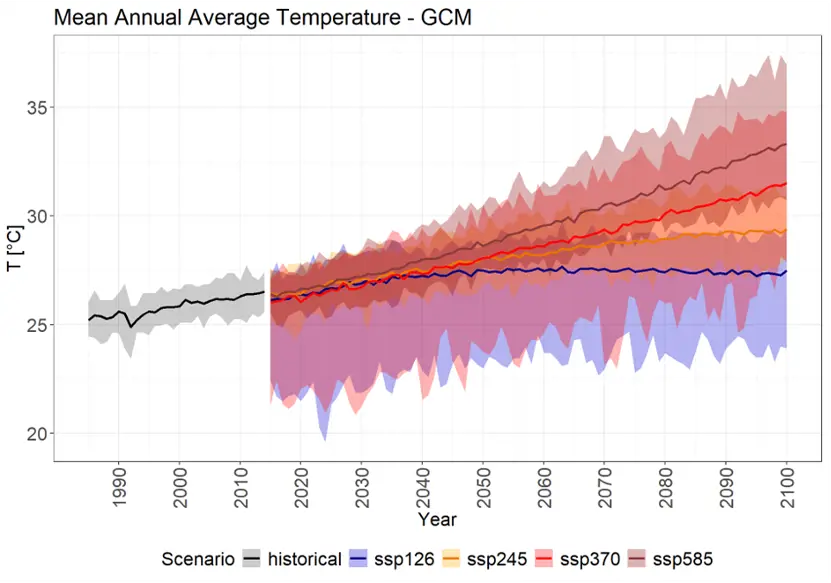
Once a robust climate baseline has been established, climate change projections can be used to assess whether water availability at the site is likely to increase or decrease. Using the latest Global Circulation Models and data science tools, (an example is presented in Figure 2) SRK develops site-specific climate projections for mining projects, quantifying changes in precipitation patterns, temperature extremes, droughts and wet periods, heat waves, and other relevant meteorological variables. Understanding the potential future variations in climate is vital for risk assessment and for the resilient, safe design, operation, and closure of mining projects.
In an uncertain future, one certainty remains: the climate will continue to influence water availability at mines and their ability to use this vital resource. To minimize risks and strengthen resilience, it’s essential to adapt proactively rather than reactively—considering environmental, social, and economic factors. SRK’s climate change specialists work closely with multidisciplinary teams to provide defensible climate scenarios and a clear understanding of associated risks. This collaboration ensures that clients receive comprehensive guidance to identify, assess and minimize risks, ultimately leading to safer and more resilient mining operations in the future.