Pre-concentration opportunities are available for most operations to improve the grade of their mill feed and eliminate fine/soft contaminants or coarse/hard materials.
For a greenfield project, pre-concentration is difficult to evaluate due to a lack of standardised testing methods and sample top-size constraints. It’s exacerbated by current testing practices, where sample preparation involves stage-crushing down to a manageable size, which destroys the opportunity to evaluate coarse beneficiation methods. Adrian is working to develop a standardised ranking test using ½ drill core samples. The objective is to consider pre-concentration at an early study stage and quantify the impact on project economics.
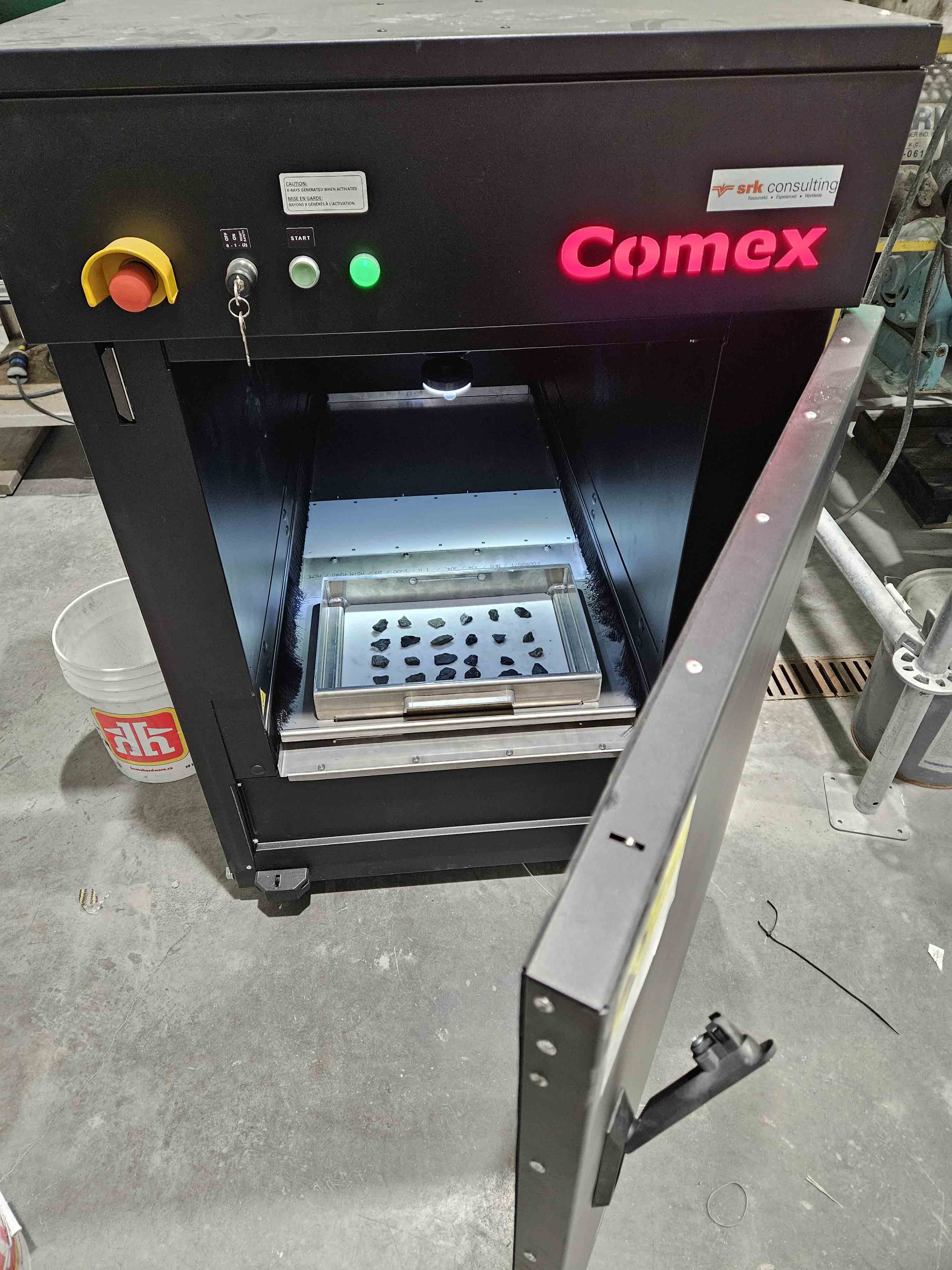
SRK Canada now offers X-ray transmissive (XRT) sensor-based testing in partnership with Base Metallurgical Labs (Base Met) in Kamloops, BC. Used in conjunction with crushing/screening, our XRT sensor testing rapidly and cost effectively assesses the potential for pre-concentration, which can then be applied to scoping or prefeasibility studies.
The laboratory test can be done on 30−50 kg of ½ core samples, measuring the metal deportment by size at different levels of impact breakage, comparable to primary/secondary stage crushing. Integrating this protocol into existing comminution test protocols minimizes disruption to metallurgical testing programs. As well as estimating the grade by size response to crushing and screening, coarse particles are tested for sensor response, typically dual-energy XRT.
SRK and Base Met test and analyse sample results using a standardised procedure, which allows for benchmarking against other projects and operations. The goal is to enhance interpretation of scan results over time using machine learning.
Our XRT sensor testing can be included in metallurgical testing programs with minimal sample loss and no disruption. It can also be supported by larger-scale performance testing already being done by sorting equipment manufacturers. Plans are underway to include an X-ray fluorescence sensor to the lab capabilities at Base Met.
See our interactive infographic.