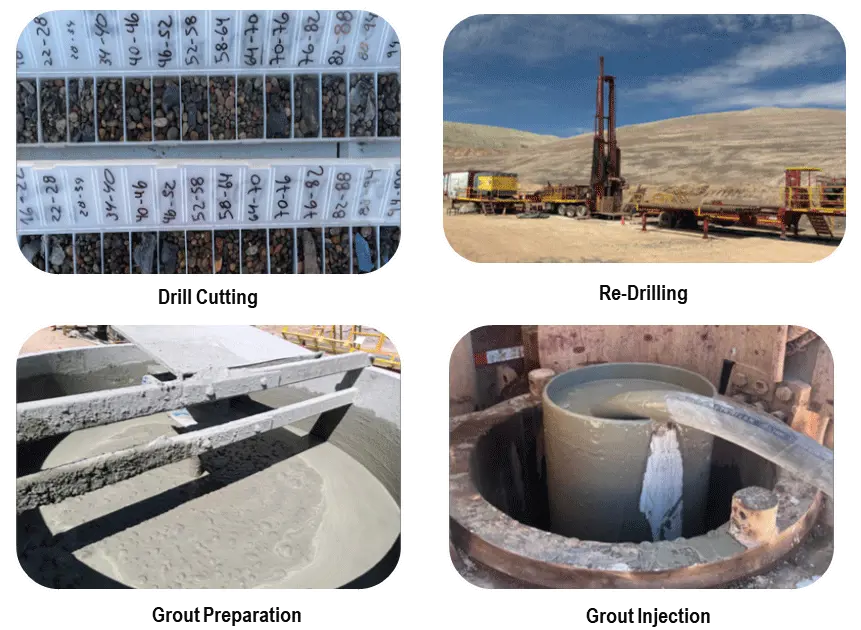
Well plugging is a hydrogeological practice used for permanent and safe closure of unused water wells, restoring natural hydraulic conditions by preventing the vertical groundwater flow between aquifers with contrasting water quality or different hydrogeological properties, and controlling or preventing artesian flow from confined aquifer systems.
At a mining operation located in the Antofagasta Region of northern Chile, an interaction between a deep confined aquifer and a shallow unconfined aquifer was identified through the interpretation of long-term groundwater level records, hydrochemical data and isotopic analyses. This interaction resulted from the drilling of three monitoring wells that intercepted both aquifer systems, establishing a hydraulic connection between them. These wells acted as preferential groundwater flow pathways allowing groundwater from the deep confined aquifer to reach the shallow unconfined system. To eliminate the hydraulic connection between the 2 systems, the wells were plugged following a three-stage methodology:
1.Dismantling
Removal of all the accessory equipment and materials from the wells that could interfere with the drilling and subsequent plugging.
2.Re-drilling
Re-drilling used the same or larger diameter to fully remove the PVC casing, gravel pack, and annular seal, ensuring direct contact between the grout and surrounding rock. Given the critical nature of this step, geological logging was performed every 2 meters.
3.Plugging:
A cement-bentonite grout was injected through a 2-inch tremie pipe from the bottom of the borehole upwards. This injection was performed in stages, with each batch limited to less than 25% of the total well volume to ensure proper placement and settlement of the grout. The cement-bentonite mixture consisted of a dense 1.4 kg/L sulphate-resistant cement-bentonite grout, with a setting accelerator additive.
Quality control of the process relied on two pillars: 1-Exhaustive mapping of the drilling cuttings which verified the percentage, shape, and type of extracted material to check the presence of rock, PVC and gravel , ensuring that the casing and seal were removed and 2 - continuous comparison of injected versus theoretical grout volume to confirm the absence of voids or residual flow pathways.