Mineral prospectivity mapping has become a key tool in generative exploration, helping reduce search spaces and prioritise areas for resource-intensive follow-up. A key challenge, however, is optimising value from data coverage across a given search space. One solution is adopting a systems-based approach that defines specific spatial proxies for key targeting criteria linked to the critical components of a given mineral system, at a range of spatial scales. In 2023, SRK was commissioned by the Saudi Arabian Mining Company (Ma’aden) to undertake a mineral systems-based prospectivity study covering a broad range of precious, base, and critical metals in the Arabian Shield.
The Arabian-Nubian Shield (ANS) records a protracted history of terrane accretion throughout the Neoproterozoic, including juvenile volcanic arcs, continental arcs, and fragments of thicker, evolved Rodinian crust. The Arabian Shield Prospectivity Study builds upon a revised geodynamic framework developed by SRK for the Arabian sector of the ANS. This framework underpins a reassessment of prospectivity for diverse deposit styles, including arc-related porphyry-epithermal and volcanogenic massive sulphide deposits, younger orogenic gold, post-collisional rare-metal granites, lithium-caesium-tantalum pegmatites, and comparatively underexplored systems such as magmatic Ni-Cu-PGE sulphides and podiform chromite.
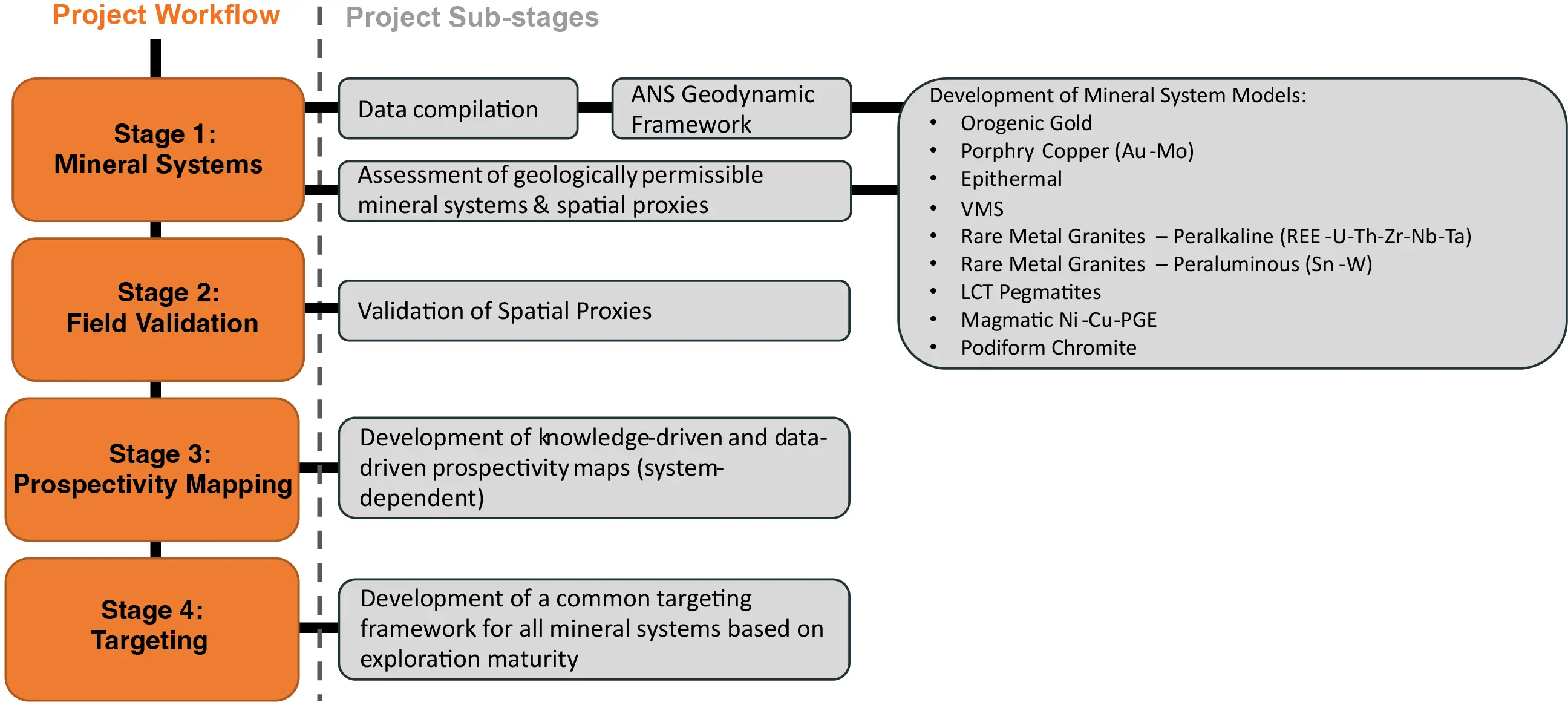
Conducted over a two-year period, the study drew on expertise in structural and field geology, geochemistry, geophysical data processing and interpretation, data science and machine learning, geochronology, and palaeo-plate reconstruction. Moreover, subject matter experts contributed detailed knowledge of critical, base, and precious metal systems. The SRK team, comprising specialists from the UK, North America, Australia, South Africa, and Exploration practices, adopted a four-stage workflow, as outlined in Figure 1 and summarised as follows:
Stage 1 – Mineral Systems: development of an integrated geodynamic model and mineral system frameworks, identifying critical parameters that control mineralisation and preservation.
Stage 2 – Field Validation: verification of key spatial proxies by SRK and Ma’aden geologists, refining evidential layers for modelling.
Stage 3 – Prospectivity Mapping: application of knowledge-driven (Fuzzy Logic) and data-driven (machine learning) approaches to both exposed and undercover areas of the Shield, chosen according to data coverage and suitability.
Stage 4 – Targeting: generation of targets at multiple scales, ranked within a common framework that enables comparison across mineral systems based on exploration maturity rather than size/area.
The study provided a revised interpretation of the Arabian Shield’s geological history, integrating multidisciplinary datasets and expert knowledge. The updated geodynamic framework, combined with mineral system models for eight deposit styles, forms the basis of the most comprehensive suite of prospectivity maps and exploration targets produced to date in Saudi Arabia. These outcomes underpin diversification of exploration in the ANS, demonstrating strong inherent prospectivity for a wide spectrum of commodities, from critical minerals to base and precious metals.