Similarly to tailings dams, we need strategic operational and tactical planning for hydro dams.
In his 1986 book Terzaghi Lectures, 1974−1982, Karl von Terzaghi proposed that a dam rating system should provide all of the following:
- A logical framework for rating the relative safety of a dam
- The use of judgment and experience (and results from analysis and historical benchmarking, when appropriate)
- Yield quantitative ratings (in this case probability of failure) for use in cost-benefit analyses
Thirty-five years later, we still have a burning question: how do we do that?
How Do We Do That?
Tailings Dam Benchmarking
Dam probabilities of failure can be benchmarked against a hundred years of historical data, although admittedly they are imperfect and heterogeneous records. Benchmarking illustrates which dams in a given portfolio are better or worse than selected benchmarks, may be better than average when compared to the world portfolio and/or may represent a clear and present danger.
This immediately allows decision-makers to understand if mitigation of key hazards and implementation of identified critical controls would significantly enhance the dam’s survivability, reducing its overall probability of failure.
For tailings dams, the benchmarks we normally use in the integrated approach are the following
Historical records do include causality comments, but these are generally imprecise, biased and have a major category titled “unknown” which makes them rather unsuited in supporting decisions.
For Hydro Dams, the Benchmark is Available
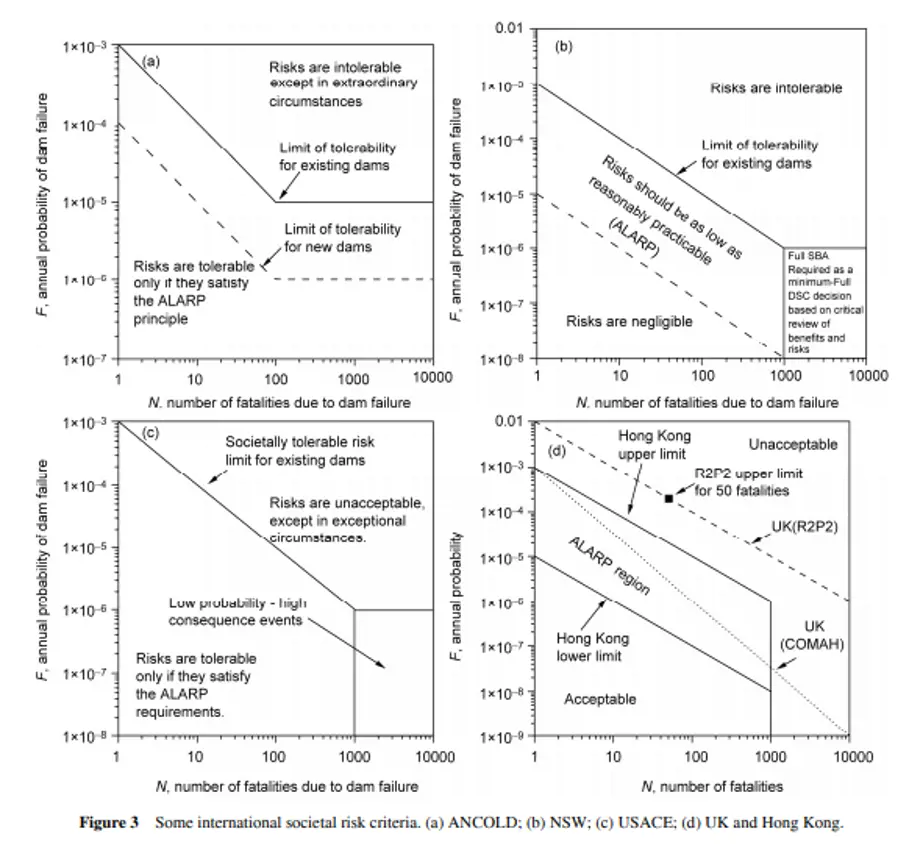
Li et al. (2015) compiled tolerances on societal risk criteria from the Australian National Committee on Large Dams (ANCOLD), New South Wales (NSW), United States Army Corps of Engineers (USACE), the UK and Hong Kong. These derived from benchmarking exercises.
Strategic Operational and Tactical Planning for Tailings Hydro Dams
Terzaghi’s dam rating point can be performed with an integrated causality approach that we presented at a conference in London and summarized in prior writeups on ORE2_Tailings™.
Tailings Dam and Hydro Dams Causality
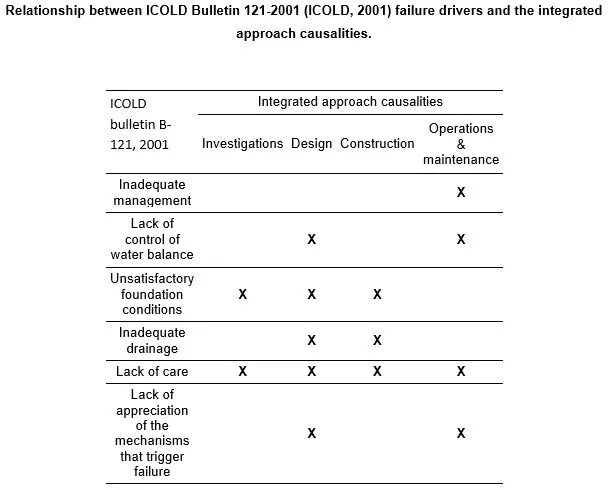
The table below shows the relationship between International Commission on Large Dams (ICOLD) Bulletin 121-2001 (ICOLD 2001) failure drivers and the ORE2_Tailings−integrated causality approach.
It becomes clear when reviewing the table that there is good agreement between ICOLD failure drivers, for example, and/or failure drivers identified based on forensic review of historical failures and the ORE2_Tailings integrated approach causalities, once the due relationships are discussed.
It becomes important at this point to also discuss the Mining Association of Canada (MAC)’s key performance indicators (KPIs) (MAC 2019). MAC designed them to help define the overarching principles of good/best tailings management. As a result, they are more general and difficult to bring into an analytical context. Below is a list of five MAC KPIs which is quite eloquent in showing the different objectives of MAC’s effort with respect to the aim of the approach described in this paper:
- Tailings management policy
- Tailings management system
- Assigned accountability for tailings management
- Tailings management review
- Operations maintenance and surveillance manual
We note that the approaches discussed in this section are complementary and have some intersections, but their objectives remain distinct. Furthermore, MAC’s approach is an index-based rating, whereas the integrated approach described in this paper transforms the KPI information into quantitative probability evaluations, allowing for portfolio prioritization, risk-informed decision- making and residual risk assessment.
Example of Integrated Causalities Approach
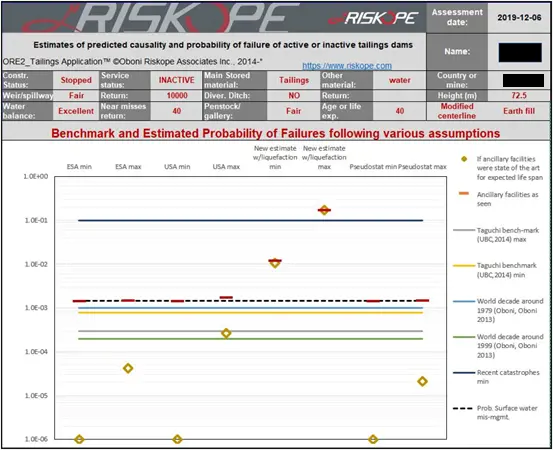
We show below an image summary example of analysis carried out with ORE2_Tailings.
In this example, we see that the probability of failure resulting from surface water management (upstream diversions, spillways) and the potential triggering of liquefaction significantly exceed the probabilities associated with the drained or undrained stability analyses and lie above benchmarking.
Conclusion on Strategic Operational and Tactical Planning for Tailings and Hydro Dams
We see that the ORE2_Tailings integrated causalities approach does offer a logical framework for rating the relative safety of a dam. It allows for the combination of judgment and experience with results from analysis and historical benchmarking. It also yields quantitative ratings (in this case probability of failure), allowing rational prioritization of risks. Finally, risk-informed cost-benefit analyses become possible.