Starting Tailings Closure Decades Early Could Save Millions, Boost Trust and Turn Mine Waste into Long-Term Assets Worth Talking About

What if the key to slashing tailings closure costs and winning community trust is to start the work decades before the mine shuts down?

For Justin Walls, Principal Consultant (Tailings Engineering) at SRK Consulting, the best time to plan for tailings storage facility (TSF) closure is now – not when the mine is about to shut down. And if you can shape and rehabilitate as you go, you’ll save money, cut risk, and win trust.

Justin has nearly two decades of international experience in tailings, water, and mine closure engineering, including more than a decade designing and constructing TSFs across southern and eastern Africa. Now based in SRK’s Perth office, he specialises in integrating water management, geotechnical stability, nature-based solutions, and stakeholder expectations into closure designs for various mine waste facilities around the world.

Speaking at an AusIMM webinar on Proactive Planning for Tailings Closure, Justin set the scene with the scale of the challenge. The 2020 Global Tailings Review estimated there are around 8,500 tailings dams worldwide containing roughly 217 cubic kilometres of tailings – almost half from copper processing. With global copper demand projected to double by 2050 to meet net-zero targets, tailings aren’t going away any time soon.

Why closure thinking starts at design

Justin said that when it comes to closure, the “short, easy answer” to what to do with a TSF is to get rid of it entirely. But in reality, full removal is rare. “It’s uncommon to completely remove tailings dams and put them back into pits,” he explained. “There are cost, logistical, and geochemical considerations, and in many cases you’d sterilise future ore if prices later make it economic to mine again.”

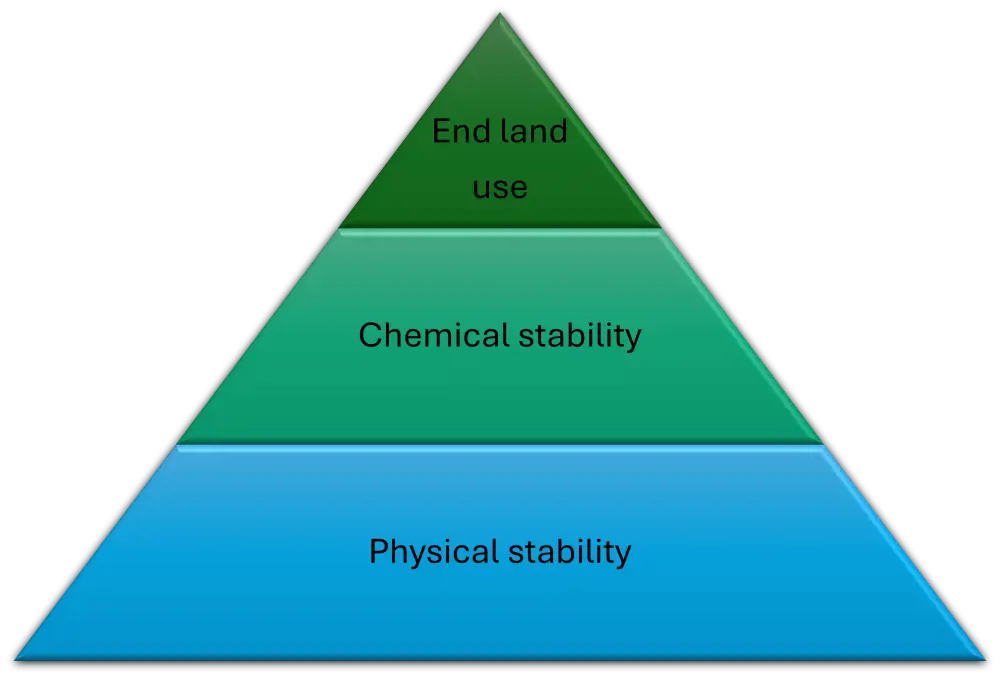
Instead, the focus is on designing for stability, environmental performance, and beneficial post-mining land use from the outset. Justin advocates for integrating closure concepts into the original TSF design – an approach now supported by the Global Industry Standard on Tailings Management (GISTM), which recommends pre-feasibility-level closure designs even for facilities still on the drawing board.

The benefits are clear: “If you can make small changes early, you can avoid major costs and risks later. Waiting until the end and doing the bare minimum to meet legislation leaves you vulnerable if legislation becomes more stringent, standards change or stakeholder expectations shift.”

The case for progressive rehabilitation

One of Justin’s strongest messages was that progressive rehabilitation during a TSF’s operational life is a game changer. He described the traditional rehabilitation approach: operating a facility to the end of its life, then reshaping steep, angular outer walls and applying covers and vegetation in one massive, expensive campaign.

By contrast, progressive rehabilitation smooths the outer slope from the outset and rehabilitates each lift as the facility rises. The lower sections then have decades to stabilise and develop vegetation before final closure, creating what Justin calls “a full-scale trial in real site conditions.”

“You’re doing it during operations, with cash flow and people on site,” he said. “You can test your cover design, your plant species mix, even rock mulching if needed – and if something’s not hitting the mark, you can adjust before committing to implementing across the whole facility.”

This approach also builds trust. “If stakeholders can see sections that have been rehabilitated for, say, 20 years, with established vegetation, it’s a powerful demonstration that your closure plan works.”

Rethinking deposition and material properties

Justin outlined other operational tweaks that can cut closure costs. One is altering deposition methods toward the end of a facility’s life to reduce the need for massive, imported fill. “Think of a TSF like a bathtub – most deposition is around the edge, so you end up with a low point in the middle. If you change to more central deposition near the end, you can fill that depression and reduce the volume of fill needed to achieve a free-draining closure landform.”

Another idea is adjusting tailings characteristics in the final years. “Could you add something to reduce permeability, neutralise acidity, or even create a nutrient bank for vegetation? In some cases, researchers have explored using tailings to sequester carbon, turning a waste into a climate-positive feature.”

The cost drivers – and how to control them

Closure cost estimates must account for technical, environmental, social, governance, and economic risks. Unknowns can inflate provisions, so reducing uncertainty is critical. Justin pointed to common cost drivers:

  • Resource availability – importing rock for buttressing or sourcing viable topsoil can be expensive if stockpiles are depleted or degraded.
  • Climate change – more intense rainfall events may require larger drainage structures or erosion controls, while shifts in local climate can affect vegetation survival.
  • Stability and erosion – designs must consider long-term performance over decades to centuries, especially for chemical stability and contaminant leaching.

Modelling tools can help. Justin highlighted dam breach assessments, rain-on-grid hydrological modelling, and landform evolution modelling as ways to predict performance, test scenarios, and communicate plans to stakeholders. Advanced visualisation – from renderings to augmented reality – can also make closure designs tangible.

Stakeholder engagement as a risk control

Justin stressed that technical excellence isn’t enough if social licence is lost. “The social licence to operate can be the most complicated licence to obtain and maintain,” he said. “Once trust with the community is broken, you can’t just throw money at it to fix it.”

He encouraged early and ongoing engagement with all stakeholders – from traditional owners and local communities to regulators and investors – to align expectations, adapt plans, and avoid surprises. Effective engagement also supports innovative post-closure land uses, from cultural spaces to wildlife reserves.

Learning from nature

A recurring theme in Justin’s closure philosophy is working with natural processes rather than against them. He advocates for nature-based solutions such as constructed wetlands for water treatment and designing landforms that mimic natural analogues.

“Nature’s done 3.8 billion years of research and development,” he said. “If you can emulate those processes, you build redundancy and resilience into your closure landform.”

This might mean creating meandering, vegetated drainage lines instead of concrete channels, fostering biodiverse ecosystems rather than monocultures, or encouraging biocrusts to stabilise surfaces against wind erosion.

Practical strategies for mines

Justin wrapped up with practical strategies any operation can adopt:

  • Early action – modify designs early. Changes on paper are far cheaper than in the field.
  • Mid-life closure reviews – assess opportunities to tweak operations well before closure.
  • Concurrent or progressive rehabilitation – trial closure designs under real conditions.
  • Interdisciplinary collaboration – go beyond multidisciplinary teams to integrate expertise.
  • Closure metrics – track progress with measures that reflect long-term resilience, not just short-term vegetation cover.

The bottom line, he said, is that proactive closure planning is an investment, not a cost. For junior miners concerned about upfront expenditure, he argued that even high-level closure concepts can reduce financial assurance requirements and improve investor confidence. “Rather than locking away millions in a closure bond, you can spend some of it progressively – reducing risk, proving your approach, and improving the final outcome.”

Turning liabilities into legacies

Justin’s central message is that TSF closure should not be an afterthought, but an opportunity. With forward thinking, operational tweaks, and a willingness to learn from both technology and nature, tailings facilities can be transformed from perpetual liabilities into stable, environmentally valuable, and socially beneficial landforms.

“It’s the crazy idea that we ought to clean up after ourselves,” he said with a smile. “But done well, closure isn’t just cleaning up – it’s creating something of lasting value.”

First published on the Rock Wrangler.

Author: Jamie Wade