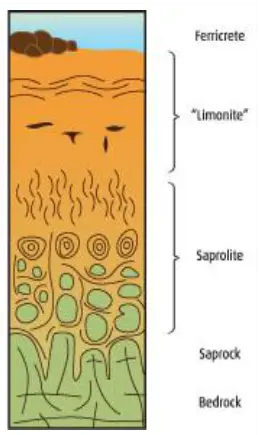
The diagram below shows a typical weathering profile for a nickel laterite deposit, developed through the intense tropical alteration of ultramafic rocks. From a processing perspective, the two key zones are limonite and saprolite.
Their contrasting geochemical characteristics largely determine the preferred processing route.
Saprolite ores are typically treated by a pyrometallurgical process known as RKEF (rotary kiln–electric furnace), producing an iron-nickel metal alloy such as ferronickel (20-40% Ni) or nickel pig iron (<15% Ni). The process relies on the saprolite’s lower iron content but yields only “Class 2” nickel—suitable for stainless- steel production yet unsuitable for batteries without further refining. In some operations, sulphur is added at the end of the process to form a nickel sulphide matte, which can be refined directly into “Class 1” (battery-grade) metal. The RKEF route, however, carries a high carbon footprint, mainly due to the large electrical-power demand of the furnace, where the power supply is often generated from fossil fuels.
As for limonite ores, they are usually processed by High-Pressure Acid Leaching (HPAL), a hydrometallurgical method that dissolves nickel and cobalt using acid at elevated temperatures (~200 °C) and pressures to maximise recovery and minimise reaction time. Although HPAL plants can be fully integrated to produce Class 1 metal or battery-grade nickel sulphate, they often generate an intermediate product that is sent elsewhere for further refining. This process is less sensitive to iron content but highly sensitive to magnesium, which consumes significant amounts of acid. While HPAL generally has a lower carbon footprint than RKEF, both methods remain capital-intensive and are therefore best suited to large, long-life ore deposits.
More recently, heap leaching has emerged as an alternative to HPAL for processing limonite and, in some cases, saprolite. Although recoveries are slightly lower and reaction times longer, these drawbacks are offset by significantly lower capital cost. Heap leaching is also more flexible and better suited to smaller orebodies.