A mining company asked us to perform a prefeasibility hazard-adjusted NPV evaluation. Our action first focused on bringing clarity in their risk register, which presented numerous classic mistakes like confusion in terminology, such as confusing risks, uncertainties and hazards.
Once the risk register was corrected, it was possible to perform the requested hazard-adjusted NPV and to draw valuable conclusions. Among these, we highlighted potential flaws of the project which warranted in-depth analyses at the prefeasibility stage.
A Note on Uncertainties
Uncertainties are triggers for mishaps of various kinds. Uncertainties contribute to many hazards but one should not double count them in the risk register as they are not hazards per se. However, they influence the likelihood of true hazards to occur.
Risk Register at Prefeasibility Stage
At the prefeasibility stage, it is possible that uncertainties may be more significant with respect to probabilities of identified hazard−generated mishaps. In that case, it is advisable to proceed with a simplified approach as discussed below.
Risk Register Hazard and Potential Fatal Flaws
Even at prefeasibility stage under major uncertainties, the risk register can be used to estimate what the potential flaws of the project and evaluate the NPV correction that should arise from the current known uncertainties and hazards.
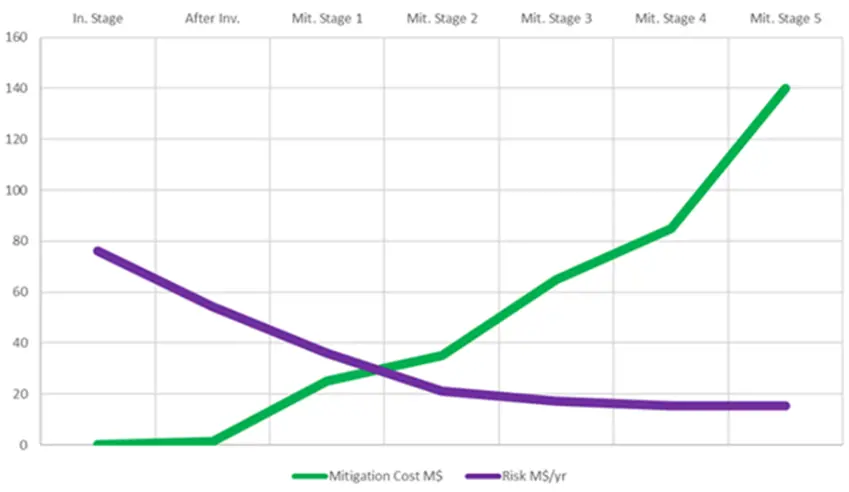
Indeed, using the uncertainties and the estimated values of the hazard impacts, Riskope was able to estimate a reduction of the theoretical NPV.
The estimated reduction of the NPV due to uncertainties and hazards was 76% in the considered case. Such a significant reduction was the sign that the project had excessive uncertainties. Our advice was not to approve the project at that time. Further analyses will hopefully reduce the uncertainties and allow the project to be approved with a better NPV.
Hazards Adjusted vs. Risk Adjusted NPV
The hazard-adjusted NPV is not the same as a risk-adjusted NPV. It is less reliable, but often it is the only value one can estimate using reasonable procedures; especially at the prefeasibility stage, there are generally too many uncertainties on key risk questions that require detailed studies and answers. These studies influence the technical and design level, as well as risk engineering.
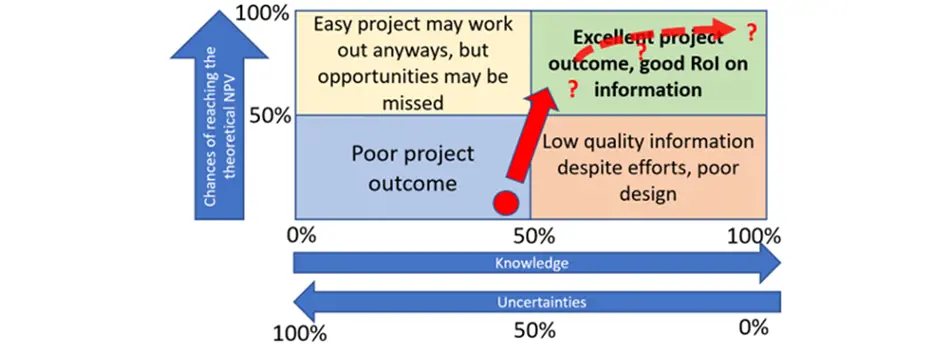
Uncertainties vs NPV
The project’s uncertainties and NPV we are using as a case history can be illustrated using the graph below. The graph has the knowledge/uncertainties in the horizontal axis. The vertical axis shows the chances of reaching the theoretical NPV.