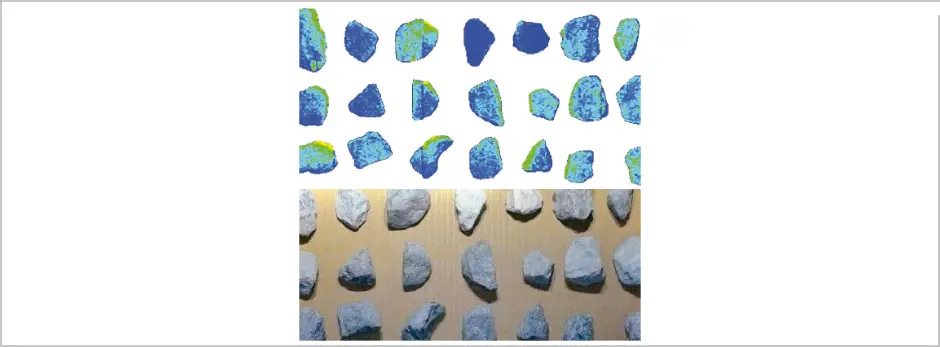
The discharge from any autogenous grinding (AG) or semi-autogenous grinding (SAG) mill consists of coarse particles that recirculate back to the mill feed as ‘pebbles’ or ‘scats’. Sometimes these pebbles are crushed, while other times they are returned intact and considered a natural consequence of primary grinding.
Increasingly, the impact of pebble recycle is being recognised by operations processing competent feed. This includes the negative effects on overall circuit efficiency, mill and pebble crushing capacity. Operations are moving to finer feed conditions, more akin to primary ball milling circuits, so why are we not assessing the impact of pebble recirculation? Have pebbles not already proven themselves competent and resilient—and, in fact, worthy of a higher cut-off grade than the remainder of the ore?
SRK Canada recently evaluated a number of AG and SAG mill pebble samples from North American copper operations for their hardness, grade distribution, and suitability for detection by X-ray transmissive (XRT) sensors. Following SRK’s laboratory protocol, the pebble samples showed a remarkable range of metal grades, which could be detected using the XRT sensor.
As pebble streams are prime candidates for particle sorting —due to their limited size range and presentation on a recycle conveyor belt —these results support rejection of the low-grade portion of pebbles. Test results found pebbles were consistent in hardness and grade across the narrow particle range. However, XRT sensing was able to identify 80% of the valuable metal in only half of the pebbles. The economics of pebble rejection, as well as pebble sorting, were found to be highly attractive for large-scale copper porphyry operations.