ORE2_Tailings™ is a quantitative risk assessment platform created by Riskope designed for tailings systems (active and inactive). When we deploy ORE2_Tailings to a portfolio of dams, possibly over multiple properties, it allows for tactical and strategic planning. Our practice has shown that ORE2_Tailings and the general ORE2_Tailings workflow deliver results similar to those of common practice quantitative approaches (like event trees, failure trees, bowties). Furthermore, ORE2_Tailings enables answering specific questions linked to the causality of potential failures, optimization of cost vs. mitigations and many more.
ORE2_Tailings is compliant with ISO 31000 and supports ICMM Global Industry Standard on Tailings Management (GISTM) conformance protocols as we showed in detail in a recent Riskope communication.
A typical ORE2_Tailings report supports risk-informed decision-making. The study is based on archival documents the client delivers for each tailings storage facility (TSF) and related dams as well as written quality assurance. The archival documents may include bowties and failure modes and effects analysis which we review and update using a variety of approaches. We compare existing assessments to ORE2_Tailings results.
Below, we summarize the general structure of ORE2_Tailings’s quantitative risk assessment reports. They are organized around Chapters 2 to 10 and closed in Chapter 11. Nine takeaways are formulated.
Chapter 2 summarily describes how Riskope uses the semi-automated ORE2_Tailings discovery platform. This helps building the knowledge base relative to the considered portfolio using received documents. The chapter closes with an archival gap analysis (Takeaway #1). The rest of the chapters refer to the received information.
Chapter 3 describes the sites, their TSFs and each one of their dams from a physical point of view.
Chapter 4 delivers the summary of the knowledge base evaluation. It attributes a general quality note to the knowledge base using the ORE2_Tailings key risk indicators for each TSF and each dam’s system. The chapter closes with a final look at archival deficiencies (Takeaway #2). The raw data we extract from the archival documents will be delivered in an appendix with a review of public space observation imagery using various sensors.
Together, the first part of the report constitutes the context of the study in compliance with ISO 31000.
Chapter 5 explains the steps necessary for the ORE2_Tailings deployment, i.e. defining the success/failure criteria, failure causality (Takeaway #3) and probabilities of failure evaluation, assessing the probabilities of occurrence of the selected failure under various conditions. Some conditions considered are ESA, USA, pseudostatic, residual strength, liquefaction (earthquake or storm, man-induced) as the available data allows. A comparison with the failure modes the client adopted for prior risk assessments is possible.
Chapter 6 uses all the information from prior chapters to deliver the below for each dam in each TSF:
- probability of failure (pf) under various conditions and events using ORE2_Tailings’ proprietary algorithms. We compare these probabilities with those in prior risk assessments. If the client has a pre-existing specific format for risk assessment, we will evaluate the results in that manner as well.
- consequences (C). We provide consequences estimations if the client did not provide their evaluations. This chapter also benchmarks the hazard of each dam with respect to the worldwide portfolio. This is based on the record of a hundred years of failures established in Oboni & Oboni (2013) and theoretically confirmed by Taguchi (2014) (Takeaway #4).
Chapter 6 then concludes with a rating based on decreasing pf*C risk (Takeaway #5) which are shown to be generally too vague for risk-informed decision-making.
Risk Tolerance
Chapter 7 delves into defining the risk tolerance thresholds from a societal and corporate perspective. In general, at the first deployment, corporate tolerance is an example drawn from prior major mining companies’ studies, thus it does not represent yet the specific client’s own corporate tolerance.
Chapter 8 shows the evaluation of risks based on pf and C developed earlier in context with the risk tolerance thresholds. It is possible to rank risks in terms of tolerance level (Takeaway #6), and to prioritize specific TSFs and dams (Takeaway #7).
Chapter 9 discusses which risks are tolerable, intolerable but manageable (i.e. tactical) and intolerable and unmanageable (i.e. strategic) (Takeaway #8).
Chapter 10 describes recommendations intended to raise the level of knowledge on the slopes/dams in the portfolio (Takeaway #9). The goal is to reach better risk estimates. It will use an example where we narrate the deployment of ORE2_Tailings from its inception. The chapter aims to demonstrate how the methodology would support owner/engineer of record decision-making throughout a mitigation project. The starting point will be prior evaluation based on extant archival information. The end point will be the selected sustainable and defensible mitigated level.
Closing Remarks
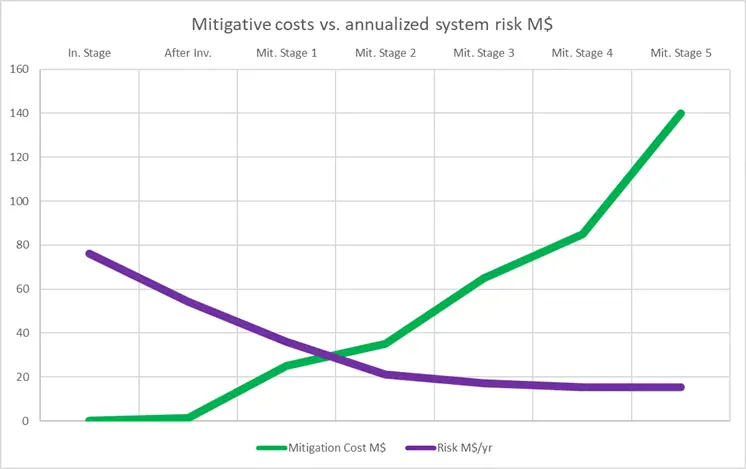
ORE2_Tailings can be deployed during the mitigation design process in order to support decision-making. The process allows operators to transparently and rationally discuss what constitutes an attainable and sustainable level of mitigation. That is possible even for slopes/dams that are above the societal acceptability criteria and will remain above corporate tolerance despite rational, sustainable and well-balanced decisions related to risk mitigation.
The illustration below shows an example of quantitative mitigation cost vs. risk abatement. It defines the As Low As Reasonably Practicable point discussed in the GISTM conformance protocols. In an upcoming post, we will explain why the crossing is a perhaps simplistic way to define the optimum mitigation level, and thus we will go beyond this to account for public opinion and enhance decision defensibility.