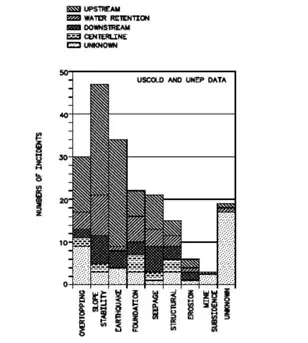
In recent years, however, in the aftermath of some of those 3−4 failures per year, expert panels have developed detailed and scientific forensic analyses that generally determine a set of circumstances that lead to failure. Those include numerous human factors that failure mode analyses generally ignore. Furthermore, it becomes clear that is not one single failure mode that caused the deterioration of the dam, but a combination of minor failure modes that contributed to the failure of the dam.
Failure Modes and Failure Causalities
So, it becomes apparent that failure modes, and in particular credible failure modes, do not necessarily explain why failures occur. Again, it is correct for a designer to use failure modes to determine a priori countermeasures, but risk assessment should look at causality.
Failure modes explain, and not even completely, how a failure could occur under the influence of a very limited set of triggers. Forensic studies have shown that failures occur because of a set of causes. A dam may fail following an unstable slope failure mode, but the causes of that slope failure are more complex.
Thus, as stated earlier, ORE2_Tailings does not look at failure modes and considers all the families of causality as potentially fatal to the dam, plus the deficiencies of the ancillary water management and other key components of the system. However, it is generally possible to create a connection between ORE2_Tailings causalities and the failure modes that engineers have considered. This allows the enhancement of the value of both approaches.
ORE2_Tailings Deployment Steps: 5.2 Dam Body Causalities (Takeaway #3)
The ORE2_Tailings causality factors for all the dam bodies in the considered portfolio will be evaluated. These causalities are derived for the dam body and do not consider the ancillary water management, decants, etc. The factors of safety value in later analysis takes into account the probability of failure of the dam system.
Furthermore, the causality analysis does not cover possible interdependencies with other dams, external factors (bridges, other structures) over spillways, and presence of decant towers or poor conditions of the spillways, including potential deficiencies of their design which will enter in the probability of failure and later discussions.
The causality families we will evaluate are construction, investigations, geomechanical testing, analyses, documentation, operations, monitoring and maintenance.
The dam body causalities always add to 100% and the min-max value for any family are respectively 5% to 50%. That means that ORE2_Tailings considers that the preponderant cause of dam body failure cannot be more than 50%. Thus, the other causalities will share the balance, in compliance with post-mortem analyses.
Takeaway #3: Comparative analysis of dam body causalities
ORE2_Tailings Deployment Steps: 5.3 ORE2_Tailings Hazard Characterization vs CDA Criteria
This comparison opens a Pandora’s box as there are many answers. We refer to CDA DAM SAFETY GUIDELINES 2007 (2013 Edition), and in particular to their below tables:
- 6-1A: Flood and Earthquake Hazards, Risk-Informed Approach
- 6-1B: Flood and Earthquake Hazards, Standards-Based Assessments
- 6-2: Factors of Safety for Slope Stability—Static Assessment
Let’s first focus on ancillary water management structures. Let’s assume the hypothetical considered dam is “perfect”, insofar it has not settled, the freeboard was designed and maintained properly, etc. If that dam is vulnerable to overtopping, then its pf is approximated by the values of the flood return in Table 6-1A, 6-1B. That means there is a wide range of potential pfs, from 1/100 (10-2) to 1/10,000 (10-4).
The same reasoning can cover seismic events. Interestingly, if a dam has a pseudostatic FoS=1, then the pf in that condition can be roughly estimated to 0.5 (50%).
Annualized Probabilities of Failure
However, this probability has to be divided by the return (in years). Thus, for example, with a return of 1,000 years the pf=0.0005=1/2,000 or 5*10-4. This illustrates that, for most dams, especially in low seismicity areas, this condition alone is not necessarily significant. In our 2019 book titled Tailings Dam Management for the Twenty-First Century, we show, however, that the combination of small seismic acceleration and related returns can generate odd results. Smaller quakes can be probabilistically more significant than larger quakes and their longer returns in terms of annual pf.
We close by discussing CDA Table 6-2. Let’s examine a hypothetical perfect dam that has a clean and complete health record from investigation to testing, design, construction, management, monitoring, maintenance, and inspections.
Let’s also say the dam is not in a seismic area and ancillary water management structures ensure a survival with a pf lower than the stability condition; in other words, flooding will never be a problem for that dam. If that is the case, a dam with FoS=1.3 would have an ORE2_Tailings pf estimate in the order of 10-4.
However, if the dam was poorly investigated, designed, etc. (i.e. the opposite of our perfect dam example), then the ORE2_Tailings probability would raise to appx 1/4 = 25%. Identical factors of safety do not mean identical probability of failure.
ORE2_Tailings Deployment Steps: 5.4 Consequences Evaluation
If the client does not provide their own consequence evaluations (for example, GISTM) we will build a consequence estimation using ORE2_Tailings’ built-in consequences with the consequence metric shown below.
The consequence dimensions of a dam failure that need to be considered include the following:
o disruption of production, including:
- work stopping for cleanup and other mitigation
- work stopping for inquiries
o fatalities and injuries
o damage to equipment and infrastructure, including inundation areas
o damages to third-party properties and fixed and mobile assets
o cleanup cost and rehabilitation of fauna, flora, and fisheries
o liabilities and fines
o legal costs