In mineral exploration, the debate often centers on whether human intelligence or artificial intelligence (AI) offers the best solutions to complex challenges. While these opposing viewpoints are intriguing, the most powerful results often come from combining both. When human expertise and machine learning work together, they deepen understanding, accelerate discovery, and enable breakthroughs that were once out of reach.
SRK has pioneered the integration of domain knowledge with advanced AI tools to address exploration challenges. The examples below show how this combined approach is improving our clients’ exploration workflows.
First, SRK has merged exploration geochemistry expertise with data science and machine learning to extract geological insights from complex datasets. By analyzing stream sediment, soil, and whole-rock data— from national to deposit scales—we identify lithologies, alteration zones, and multi-element metal anomalies. Data science tools reveal patterns, while geochemists interpret and integrate them into exploration models. This approach surpasses traditional geochemical methods, efficiently handling large datasets and reducing data noise. The outcome is a sharper, more actionable understanding of geochemical patterns that guide exploration success.
Geological mapping has also advanced through the integration of deep learning with satellite imagery. SRK has developed AI models trained to recognize geological features such as alteration signatures of known deposits, gossans, and artisanal workings. Informed by field observations, these algorithms can be applied over vast areas, enabling country-scale exploration campaigns. The method saves time and ensures that key geological features are detected accurately, even in remote regions.
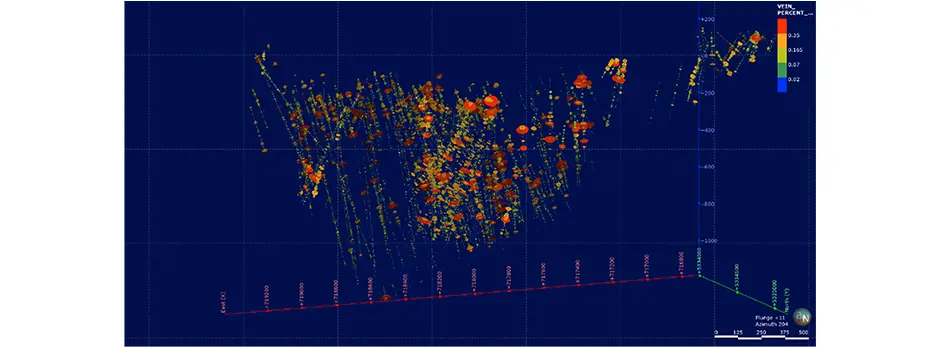
The interpretation of structural features in drill core has long been challenging and subjective. SRK addresses this by combining core photography, deep learning computer vision, and structural geology expertise to map features such as veins, rubble, gouge, foliation, and breccias. The labeling approach produces reproducible, descriptive outputs rather than interpretations. Structural geologists can then use these data to model the 3D architecture of faults and shear zones controlling mineralization. Automating this step generates consistent, detailed data that strengthen expert interpretations.
These examples show that human expertise and AI can be more effective together than apart. By combining the strengths of both, SRK is applying approaches that help address complex exploration challenges. This partnership between human and artificial intelligence is not only influencing the future of exploration—it is defining its present.