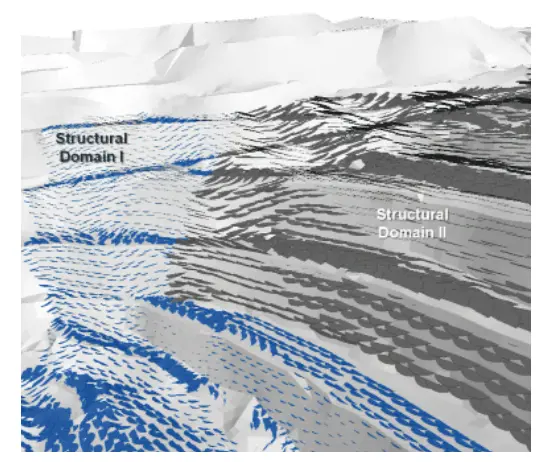
SRK Chile’s Rock Mechanics team has more than 25 years of experience working in several geotechnical and hydrogeological studies at the Maricunga gold belt deposits. The Maricunga District is elongated to a north-south orientation between latitudes 26° to 28°S. It extends for approximately 200 km in length and 50 km in width. Regional geology is dominated by the Miocene to Pliocene volcanic rocks and portions of an exposed Paleozoic-Triassic basement. The older basement of Paleozoic and Mesozoic igneous and sedimentary rocks is unconformably overlain by the Miocene volcanic rocks (see Gamonal 2015). The main rock types associated with mineralization are breccias, usually under a very complex structural pattern. On the other hand, host rocks are mainly volcanic sedimentary rocks, mudstones, sandstone and shale (top image).
To develop comprehensive geological, geotechnical and structural characterization, geotechnical units, three-dimensional structural models and a geotechnical block model need to be defined. Thanks to previous experience at several gold deposits located in the same area, the slope design can be carried out with considerable confidence. Back analyses play an important part in the confidence of design. As part of the slope design process and slope optimization, the past performance of the pit slopes needs to be assessed for the future pit pushbacks.
The main challenge for slope stability analyses is to incorporate the anisotropy associated with the sedimentary folded rock with a practical approach. To incorporate the strength anisotropy, a novel constitutive model was defined for three-dimensional numerical models (bottom image). A sophisticated mesh using griddle software was used to incorporate anisotropy based on the ubiquitous approach. For anisotropy, the use of constitutive models accounting for the effects of discontinuities in nonlinear strength curves is required. A proposed approach relied on the “Subiquitous Joint Model” (see Montiel et al., 2024) aligning the bilinear envelope with the strength properties to observe the impact of the discontinuity sets.