SRK has developed and applied a suite of risk-assessment tools that integrate with clients’ existing processes. They give operators a clearer understanding of tailings storage facility (TSF) risks, a consistent way to compare facilities, and practical basis for directing time and capital to where they will reduce risk the most.
Examples include:
- A rigorous process for identifying risks and potential failure modes.
- Development of a benchmarking tool for assessing risks across TSF portfolios.
- Quantitative risk assessments (QRAs) to better characterise site-specific risks and uncertainties.
Risk Identification Process
Because many historical failures result from a combination of “unforeseen” events, often due to normalization of deviance over time, SRK conducts structured workshops where participants systematically review initiating events, hazards, and conditions, relevant or not, and explore how these could interact to cause failure. Having been applied at over 50 TSFs, this process consistently uncovers previously overlooked failure modes and hazards, providing a more comprehensive and defensible foundation for risk management.
TSF Risk Benchmarking Tool
SRK has developed a benchmarking tool that uses key performance indicators (KPIs) to estimate the probability of TSF failure. These KPIs include both quantitative inputs, such as design flows and safety factors, and qualitative inputs, such as material characterization quality. The tool is most effective when applied to a client’s entire portfolio, as it generates plots comparing failure probabilities across multiple facilities and global benchmarks. The tool also converts all consequences into equivalent dollar values, allowing for a direct comparison of risks across a portfolio. This helps clients prioritize resources for maximum risk reduction, even when risks are driven by qualitative consequences such as environmental, health, or social impacts.
Quantitative Risk Assessments
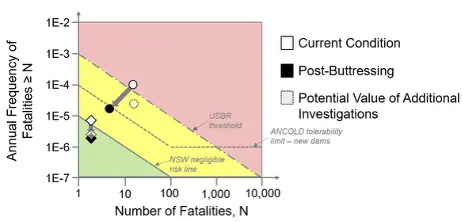
TSFs are generally required to meet deterministic factor of safety (FOS) thresholds to be considered “safe.” However, many facilities do not meet these standards and require remediation measures (e.g. buttressing). Deciding which facilities to prioritize can be challenging. QRAs consider the uncertainties underlying FOS estimates, often producing very different failure probabilities even when FOS values are identical. In one case study, the QRA results showed high value in performing additional investigations, not because they change the true underlying risks, but because they improve understanding enough to significantly reduce buttress-size requirements.
Clear communication is as important as the analysis itself. Deliverables from these tools range from detailed failure-mode registers and schematics linking monitoring activities to TSF safety, to portfolio-level visuals that are easily digestible and actionable for decision-makers. Together, these tools strengthen risk governance, improve accountability, and enable operators to demonstrate measurable progress toward sustainable tailings management.