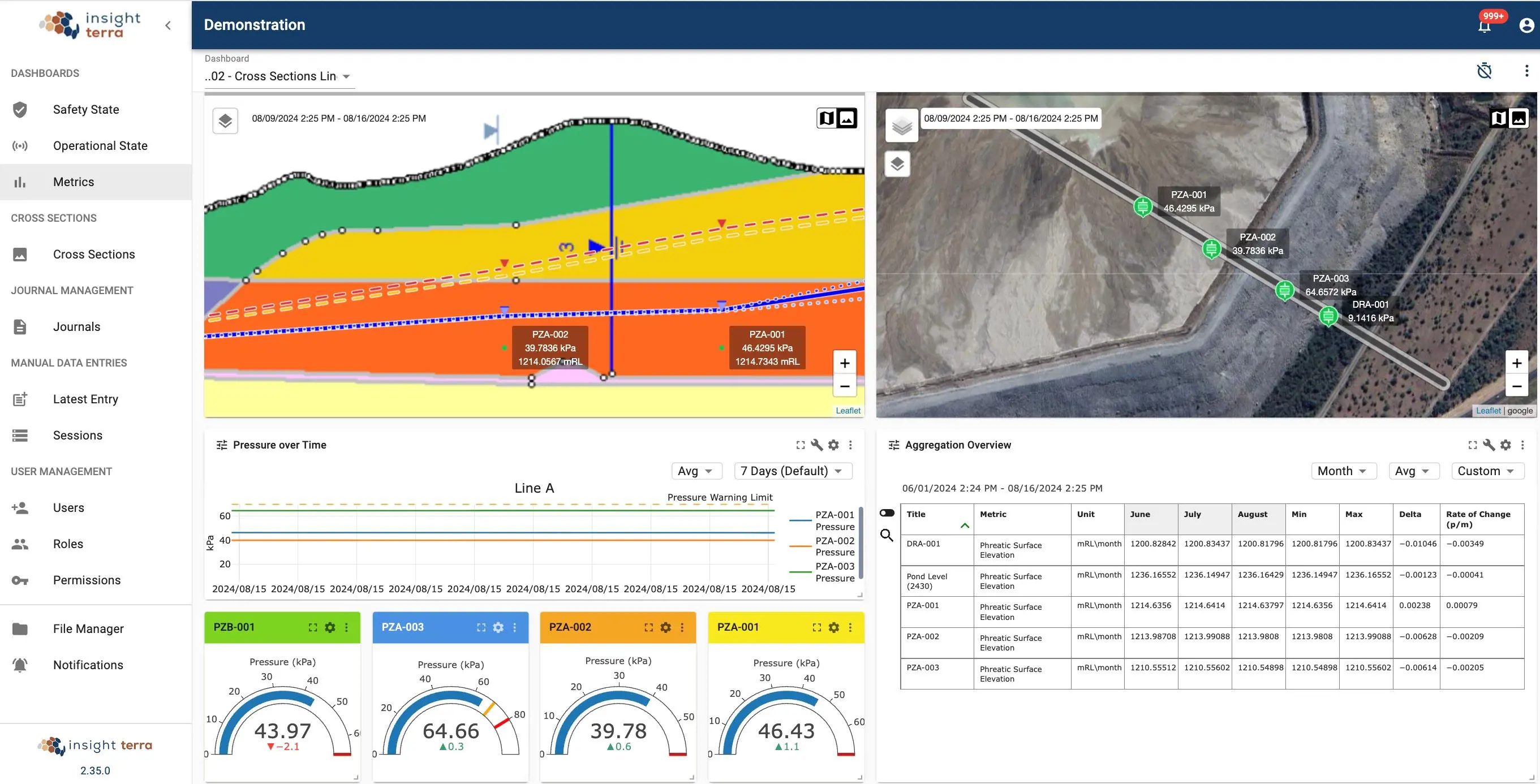
Since the introduction of the Global Industry Standard on Tailings Management (GISTM), the mining industry has experienced a clear trend towards digital transformation aimed at enhancing governance and best practices in tailings dam management. The adoption of new and advanced technologies and digital solutions has been rapid but is still evolving. This presents significant opportunities for continued innovation and improvements in Tailings Storage Facility (TSF) performance monitoring and overall TSF risk management.
The adoption of technologies and digital systems across stakeholders has been essential to achieving an increased understanding of a facility’s risk profile. This focus has led to the introduction and implementation of a wide range of monitoring and digital solutions.
Remote-sensing methods, such as interferometric synthetic aperture radar, are now widely used to monitor ground movement. These methods work well when combined with global navigation satellite systems and ground radar solutions. Drone and aerial surveys, offering high-quality thermal and LiDAR payloads, are commonly deployed. Autonomous aerial solutions further improve the frequency and accuracy of data acquisition. In situ monitoring instruments, such as vibrating wire piezometers and inclinometers, have become standard tools for TSF monitoring. Additionally, new solutions like fibre optics and passive seismics provide further options to meet specific client or engineer needs.
Implementing an effective monitoring framework must be approached on a case-by-case basis. This involves a thorough review of the TSF, identification of data gaps and the implementation of appropriate solutions to enhance performance monitoring and safety. Correctly implemented solutions and integrated software platforms enable digital dashboards to provide real-time actionable insights into critical data. Rapid data collection, aggregation, transformation, validation, processing, storage and visualisation allow prompt communication of operational performance changes to stakeholders, tailored to end-user requirements. This represents a significant improvement over past workflows.
These advancements in capability driven by technology will continue to play an important role in sustainable tailings dam management and performance monitoring. They are essential for achieving higher standards of governance and operational assurance. We have already seen the benefits of accurate data gathering, increased data visibility and auditability, ensuring better analysis, insights and risk management. Leveraging current and new technologies such as machine learning and artificial intelligence coupled with industry collaboration and innovation will certainly play a strategic role in the next phase of this digital journey.
Contact the author in the SRK Johannesburg office.