Globally, many environmental impact assessment (EIA) regulatory frameworks require practitioners to identify and assess cumulative impacts. However, EIAs often fail to adequately evaluate these effects, usually because of a lack of clarity regarding the approach. As it is now considered critical to understand the additive, synergistic and interactive consequences of a project, cumulative impact assessment (referred to here as CIA) has evolved over the past three decades from a loosely defined, risk-based concept into a more structured practice.
Several guidance documents have been prepared by international lenders and multilateral agencies to support developers in assessing their cumulative impacts. The 2013 Good Practice Handbook on Cumulative Impact Assessment and Management prepared by the International Finance Corporation (IFC) is widely used and defines the six-step process, which are integrated into the case study.
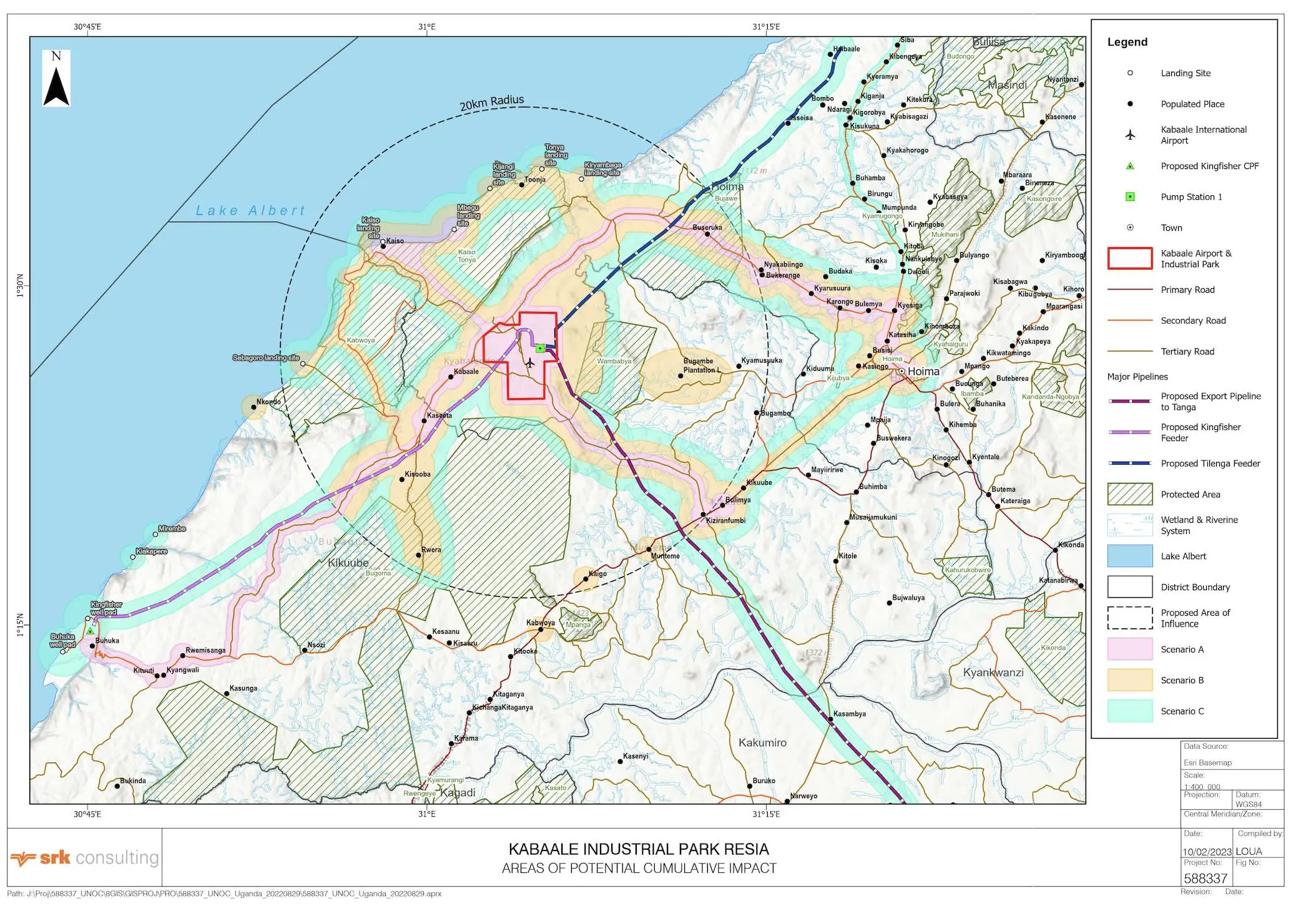
The ESG team based in Johannesburg, has applied the IFC’s CIA methodology on several projects in Africa. In 2023, SRK served as technical advisor to a regional environmental and social impact assessment for the Kabalega Industrial Park (KIP) project near Lake Albert in Uganda. Developed by the Uganda National Oil Company, the multi-component KIP includes an international airport, an oil refinery complex, industrial and commercial zones, and associated oil pipelines from three major oil fields, each with a separate EIA.
The CIA considered a range of potential cumulative impacts, including influx-induced pressure on social services and livelihoods, exploitation of forest resources, habitat fragmentation, and overexploitation of Lake Albert. Initially, valued environmental and social components (VECs) were identified, then spatial and temporal boundaries and environmental drivers defined.
These three initial steps set the scene for the assessment of cumulative impacts using a scenario-based spatial and temporal analysis approach.
The two analytical steps involved the assessment and significance of identified cumulative impacts. Under scenario A, potential cumulative impacts associated with the KIP were evaluated. Scenario B added other developments within a defined 20 km area of influence while scenario C also considered planned regional projects. These scenarios were mapped using GIS overlays to identify significant cumulative impact areas. The base layer featured key infrastructure, VECs and KIP. By identifying the accumulation of impacts on VECs, it was possible to map the likely extent of the cumulative effect for each scenario. The significance of each scenario was assessed using a 6x6 evaluation matrix, indicating severity on the one axis and extent on the other axis.
The sixth step involved the development of tailored strategies that informed KIP’s wider governance systems and strengthened project-specific management plans. It demonstrated how cumulative impacts assessments can support more integrated project outcomes.
As the CIA practice continues to evolve, there is now a growing range of examples and tools available. By combining diverse data sources, engaging experts in a collaborative way, and applying a strategic analytical approach, it is possible to deliver in-depth and insightful analyses of projects’ cumulative effects.