Often when explaining risks to management or the public, “demands for zero risk” objections arise. Repeatedly, stakeholders may point out that any “non-zero” risk is unacceptable. In the aftermath of any recent accident, the public, regulators, law enforcement agencies and the media vehemently embrace that vision.
However, the first reaction should be to declare that goal as unrealistic, as any endeavor has intrinsic risks. We are exposed to hazards and resulting risks every day, but we are more ready to accept voluntary risks than involuntary ones. Nevertheless, it is a vain goal to expect zero risk in any human endeavor.
Risk Tolerance Helps Against Demands for Zero Risk
More realistic goals may be As Low As Reasonably Practicable (ALARP) mitigation or the implementation of Best Available Control Technology (BACT). Both ideas are open for discussion as even their definitions are debatable and clouded with uncertainty: what is reasonable or possible? Finally, what is available?
In fact, the response to such demands depends on the assessment of their source and the quality of the request.
For operational risks, the demand for ALARP/BACT may be reasonable and leads to low, generally tolerable exposures within sustainable mitigative budgets. In some cases, however, the demand for zero risk may simply be a tactic to make a strong point.
Different Risk Tolerance Thresholds
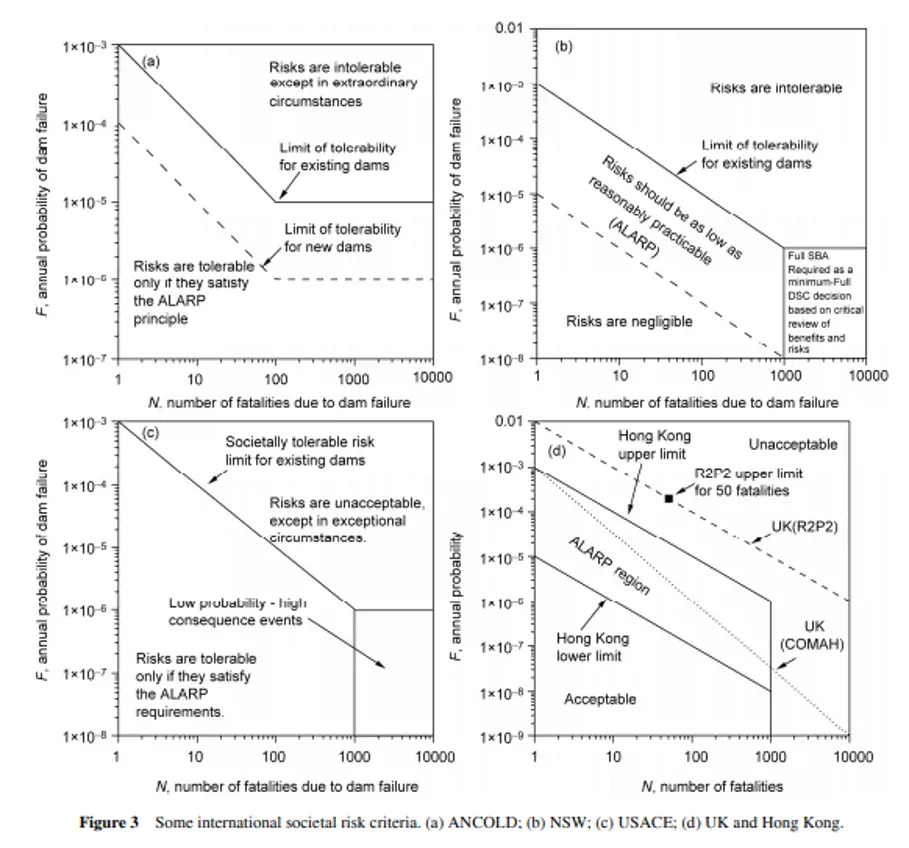
A paper from Li et al. (2015) shows a comparison of tolerances across different institutions such as Ancold (2003), HSE (1989), USBR (2011), USACE (2010), NSW-Australia (2006), CDA (2007), BC Hydro (1997), Netherlands (2000) and Hong Kong (1993).
These tolerances are defined in terms of upper limit fatalities per year for existing dams and new dams. The limit for existing dams is generally more lax than for new dams. The codes that define a lower limit generally place it at credibility level (10-6). Finally, most codes suggest that “life safety risks should be reduced below the limit of tolerability to the extent that is dictated by the ALARP.” However, numerous variations exist. As a result, detailed study of each regulation should be performed.