Resource estimates prepared for projects in former Soviet Union countries often rely on historical data that is several decades old. This historical data can have a high risk of bias due to the limitations of sample collection, sample preparation and analytical methods and tools used at the time. A challenge for resource estimation is to identify and account for such biases so that the maximum benefit can be extracted from the historical databases.
In 2019−2022, SRK Kazakhstan completed the first Mineral Resource Estimate (MRE) reported according to the JORC Code for the Kyzyl-Alma epithermal gold mine in Uzbekistan. Kyzyl-Alma is an operating underground mine which commenced production in 1976. Mining is carried out by sublevel caving.
The information available to support the MRE included detailed verification drilling of historical underground channel sampling and historical diamond drilling.
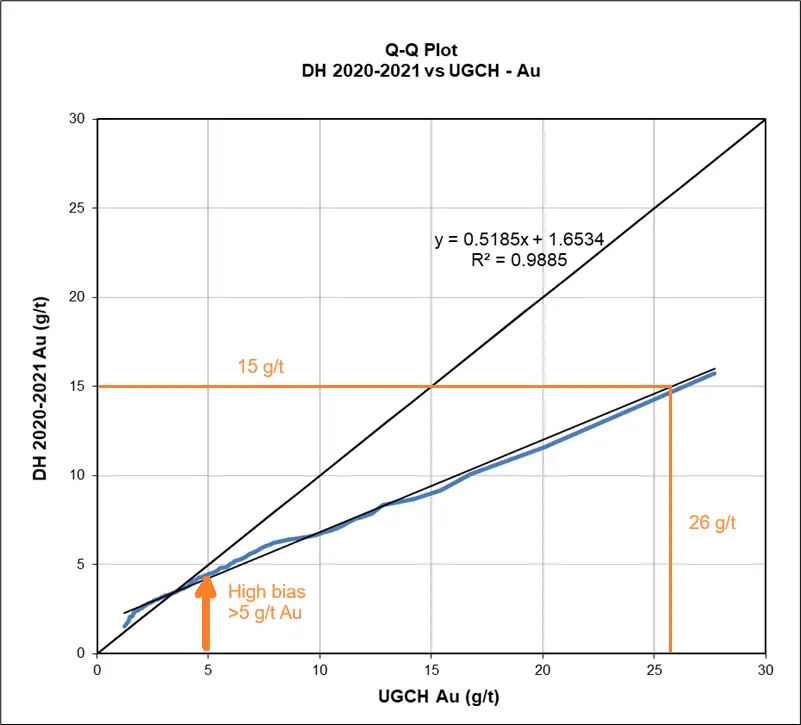
SRK investigated the difference in Au grade between the 2020−2021 diamond core samples and the historical underground channel samples, inside a common volume to remove any locational bias from the comparison. A 25 m buffer was created around the channels within this volume. The statistical properties of the composite grades from core and channel samples were assessed. Separate block grade estimates were undertaken, first using only drillhole data and second using only channel data. Adjustment factors derived from the common volume block model for Au were applied to the Au and Ag values of all underground channels and historical surface and underground drillholes.
Q-Q plots illustrating the relationship between the 2020−2021 drilling and original underground channels (left) and channel grades after application of the adjustment equation obtained from the linear regression factor (right). Factored grades also showed strong reconciliation to the plant in both grades and contained metal, which was within 10% difference.
This bias (historical data high relative to verification sampling) is considered to be the result of a combination of historical laboratory bias and sampling bias leading to samples not being satisfactorily representative. The results of the production reconciliation allowed for a confident application of an adjustment to the historical grades. As a result, SRK was able to quantify the bias in raw data and use both historical and recent sampling data to support Indicated and Inferred Mineral Resources.