Objective
This course aims to build practical understanding of the social requirements embedded within the Global Industry Standard on Tailings Management (GISTM). The course will focus on the key areas of meaningful engagement, human rights and effective grievance mechanisms and the importance of these in unlocking many of the GISTM Requirements. This course is for both tailings engineers and sustainability/social/environmental specialists to better understand their roles in conforming with, and ongoing implementation of, GISTM. Through cross discipline knowledge transfer, case study examples and group activities this full day short course will equip attendees to navigate the social aspects of GISTM with confidence.
Course Summary
The Global Industry Standard on Tailings Management (GISTM) is widely seen as the benchmark for responsible tailings management with many global miners already committed to and actively pursuing its implementation. However, reaching conformance has taken longer than anticipated with the main reason cited as ‘social aspects’. Despite people being the centre of GISTM, the social aspects remain the most challenging aspect to implement as they require time to build relationships and collaboration from multiple parties to inform decision making. And while considerable attention has been placed on engineering components, the social dimensions of the GISTM remain less understood and inconsistently applied. This full-day course provides a comprehensive exploration of the social aspects of the GISTM, covering meaningful stakeholder engagement, embedding human rights and effective grievance mechanisms. The aim is to demystify the interconnected nature of GISTM and demonstrate how multiple disciplines are required to iteratively input throughout the GISTM journey. Attendees will gain practical tools and applied examples to strengthen alignment with GISTM across diverse operating contexts.
Detailed Course Description
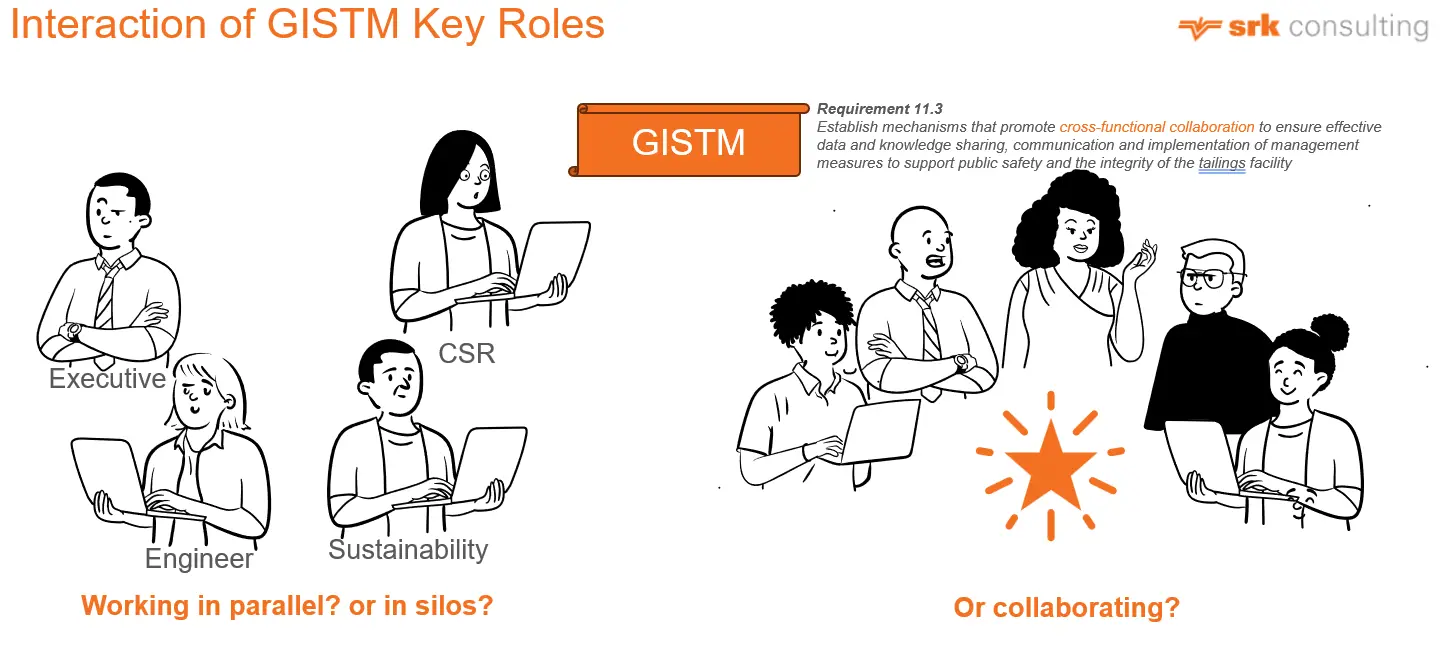
This full-day course offers an in-depth, practice-focused exploration of the social aspects embedded throughout the GISTM. By bringing together tailings engineers and sustainability/social/environmental specialists to discuss tailings management, we aim to reduce silos and practically demonstrate the value of collaboration that GISTM demands – as illustrated in Requirement 11.3. The course begins with an overview of GISTM’s structure, with emphasis on Principles and Requirements where social considerations are most prominent. Attendees will initially work through the social Requirements of GISTM before collaborating to bring that knowledge into engineering decisions, such as the dam breach analysis and emergency planning. Through presentations, group exercises, and discussion of real-world examples, participants will develop an appreciation of the collaboration required for successful GISTM conformance and continued implementation. Key themes include:
- Multi-discipline collaboration for effective, meaningful risk management.
- Demystifying social aspects related to Requirement 1.1 human rights, Requirement 1.3 stakeholder engagement and Requirement 1.4 grievance mechanism.
- Demonstration of the value of including social context early and continuously to GISTM workstreams.
Presenters
- Emily Harris | Principal Consultant (ESG), SRK Consulting
- Alice Evans | Senior Consultant (Sustainibility), SRK Consulting
- Teresa Steele-Schober | Principal Consultant (ESG), SRK Consulting
- Richard Martindale | Principal Geotechnical Engineer, SRK Consulting
Click here to view other short courses and presentations at this event.