Session 4C: Mudrush/Inrush
Abstract
Mud rush events remain a critical geotechnical and operational hazard in block and panel caving mines, reflecting the importance of understanding the mud-forming material potential as the cave matures. A consistent laboratory approach is required to describe the processes by which intact rock and fragmented material may evolve into fine-grained, flowable material under caving conditions. This paper summarises the mud rush risk assessment, which focuses on laboratory testing approaches used to characterise material behaviour associated with mud-forming potential and flowability.
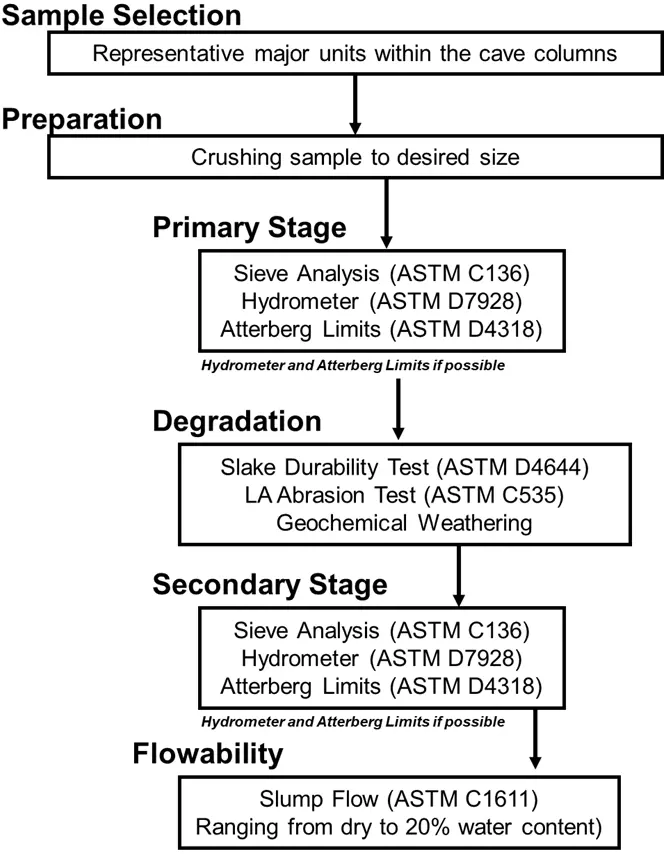
The framework integrates existing operational experiences with modified laboratory testing to evaluate fines generation, physical and chemical weathering, and water sensitivity that reflects cave conditions. Fragmentation and fines generation are assessed through particle size distribution analysis, while durability loss associated with physical and chemical weathering is addressed through repeated wetting and drying cycles and chemical exposure testing. The influence of water is evaluated using Atterberg limits to characterise plasticity, consistency, and water retention behaviour. Material flowability is assessed through the slump flow test to assess its flow potential under saturated conditions. The laboratory testing framework, therefore, can be applicable across caving operations, which supports consistent assessment of mud-forming potential relevant to mud rush risk.
Authors
- Jovian Varian | Rock Mechanics Consultant | SRK Canada (Presenter)
- Jarek Jakubec | Corporate Consultant (Mining) | SRK Canada
- Andy Thomas | Principal Rock Mechanics Engineer | SRK Canada
- Hang Xu | Senior Rock Mechanics Engineer | SRK Canada
Click here to view other presentations at this event.