Technical session: Probabilistic Risk & Stability
Abstract
Tailings facilities behave as interconnected systems in which geotechnical, operational, and hydrological elements interact in ways that are not fully captured by traditional qualitative risk frameworks. At many sites, risk assessments remain descriptive and failure-mode specific, relying on color-coded matrices that do not show how multiple mechanisms combine to influence overall dam performance. This limitation is particularly important when evaluating interactions among pore pressure conditions, strength reductions, operational deviations, and progressive deformation. This paper presents a quantitative framework that translates structured failure mode identification and engineering judgement into a system-wide probabilistic model, illustrated through an anonymized tailings facility.
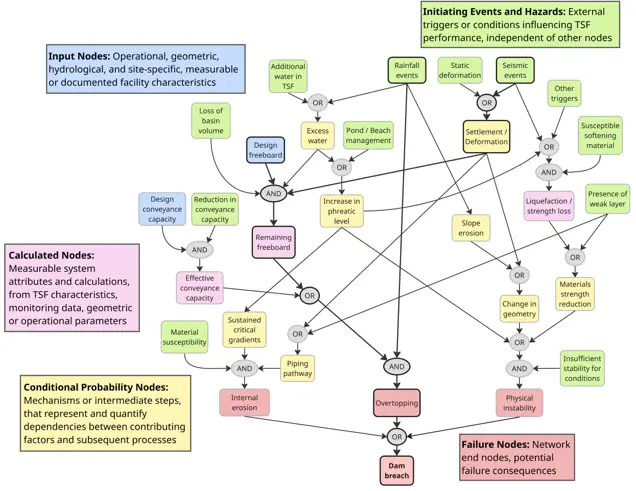
The methodology begins by expressing each identified failure mode as a simplified fault-tree component grounded in geotechnical understanding, including triggers related to drainage performance, shear strength variability, foundation response, tailings beach conditions, and operational deviations. These components are then integrated into a causal network that captures common causes and interactions among mechanisms, allowing small degradations to accumulate or propagate through the system. The assessment therefore moves beyond isolated failure modes to evaluate combined system behavior.
Once populated with probabilities derived from slope stability analyses, seepage assessments, monitoring data, and operational information, the network produces continuous risk outputs. These include frequency-number (F-N) and frequency-cost (F-Cost) curves, which portray annualized failure frequencies and consequence ranges more transparently than categorical matrices. As the outputs are quantitative, they support scenario comparison, evaluation of mitigation effectiveness, and clearer communication of uncertainty.
The case study shows how the integrated model highlights dominant contributors, reveals interactions not visible in matrix-based systems, and provides a traceable basis for evaluating mitigations while retaining engineering judgement and reducing the reliance on ordinal rating scales. The objective is to provide practitioners with a practical and transparent method for integrating multiple failure mechanisms into a coherent assessment of tailings dam risk and system behavior.